
- Nursing homes
- 10 mins
Through our conversations with nursing homes and home care providers across Europe, we keep hearing the same challenge: How do you maintain overview during the night without constantly disturbing residents?
For many care teams, especially during understaffed night shifts, getting that overview is easier said than done.
Staff often move from room to room to check whether residents are present, sleeping, restless, or need assistance. These checks are important—but they also take time and can interrupt residents' sleep.
The result is a difficult balancing act between resident safety, privacy, and limited resources.

The reality of a night shift in a nursing home
Night shifts look very different from day shifts.
There are fewer staff members on duty, ratios of one caregiver to 30–50 residents are not uncommon, but the responsibility remains the same. Residents may need assistance getting out of bed, using the bathroom, repositioning, or simply reassurance during the night. The challenge is that caregivers often have limited visibility into what is happening behind closed doors.
Without that overview, many staff rely on routine checks to understand who may need attention and who is resting comfortably. These checks are important, but they create a challenge. Care teams want to ensure residents are safe and comfortable while also respecting their privacy and avoiding unnecessary sleep disruptions.
Many caregivers begin their rounds with a simple question: Where should I start?
Without clear information, the answer often involves checking multiple rooms before priorities become clear.
Sleep-related issues are a major source of workload
Sleep disturbances are common among nursing home residents, particularly those living with dementia. A study conducted across 38 German nursing homes found that:
- 78.4% of nurses regularly dealt with resident sleep disturbances during night shifts
- Sleep-related issues accounted for 23.1% of perceived workload burden among nursing staff
For staff, this means balancing the need to monitor residents while preserving a calm environment that supports sleep. The same study concluded that sleep disturbances represent a significant and often underestimated burden for nursing home staff.
Workforce shortages make the overview even more important
The challenge becomes even greater when staffing levels are limited. Across Europe, long-term care providers continue to face workforce shortages while demand for care increases.
According to the OECD, demand for long-term care workers is expected to grow significantly in the coming decades as Europe's population ages, creating additional pressure on nursing homes and care providers already struggling to recruit and retain staff.
When a small number of caregivers are responsible for many residents overnight, time becomes one of the most valuable resources available. Every unnecessary room check takes time away from residents who may need care or immediate support.
Fall reduction in nursing homes remains a priority
Falls are one of the most common safety concerns in long-term care.
According to the World Health Organization, between 30% and 50% of people living in long-term care facilities experience at least one fall every year.
In practice, care teams often face a difficult balance. Routine room checks help ensure residents are safe, but they can also disturb sleep. When residents are woken during the night, some may get out of bed to use the bathroom or move around while still tired and disoriented, potentially increasing the risk of a fall.
While there is no single solution to fall prevention, many nursing homes are looking at how better awareness of resident activity can contribute to fall reduction strategies.
Understanding when residents leave their beds, become unusually restless, or show changes in their normal patterns can help staff prioritize their attention more effectively.
Better overview in nursing homes starts with better information
Most caregivers are not looking for more technology. They are looking for better and simpler information. Information that helps them understand where attention is needed without adding more work to their shift.
In conversations with nursing homes and municipalities, we repeatedly hear requests for:
- Better overview during night shifts
- Fewer unnecessary routine checks
- More privacy for residents
- Simpler workflows for staff
- Technology that requires minimal training and implementation
The goal is not to replace clinical judgement. The goal is to help caregivers spend less time searching for information and more time providing care.
How can nursing homes improve visibility during night shifts?
There is no single solution to the challenges of nighttime care.
However, many nursing homes are looking for ways to help staff gain better visibility into resident activity without adding complexity to their workflows or disturbing residents unnecessarily.
Some practical approaches include:
- Prioritizing residents based on need rather than relying solely on routine rounds
- Reducing unnecessary room checks that may interrupt sleep
- Improving awareness of prolonged bed exits during the night
- Identifying changes in sleep patterns over time
- Giving staff access to relevant information before entering a resident's room
For care teams, better information often leads to better decisions.
Knowing that a resident has been out of bed for an extended period may help staff decide where attention is needed first. Understanding how a resident's sleep has changed over several nights can provide valuable context for care planning. Having visibility into overnight trends such as respiration, heart rate, movement, and bed occupancy can help staff start their shift with a clearer picture of resident well-being.
The goal is not to collect more data. The goal is to help caregivers spend less time searching for information and more time providing care.
Because when staff have better visibility, they can prioritize more effectively, reduce unnecessary disruptions, and focus their attention where it matters most.
Supporting care teams without adding complexity
This is one of the reasons Ably Medical has expanded its focus on nursing homes, home care, and municipal care services.
LYNG is a Class I medical device placed under the mattress that provides awareness of presence and in-bed movement without requiring wearables or direct contact with the resident.
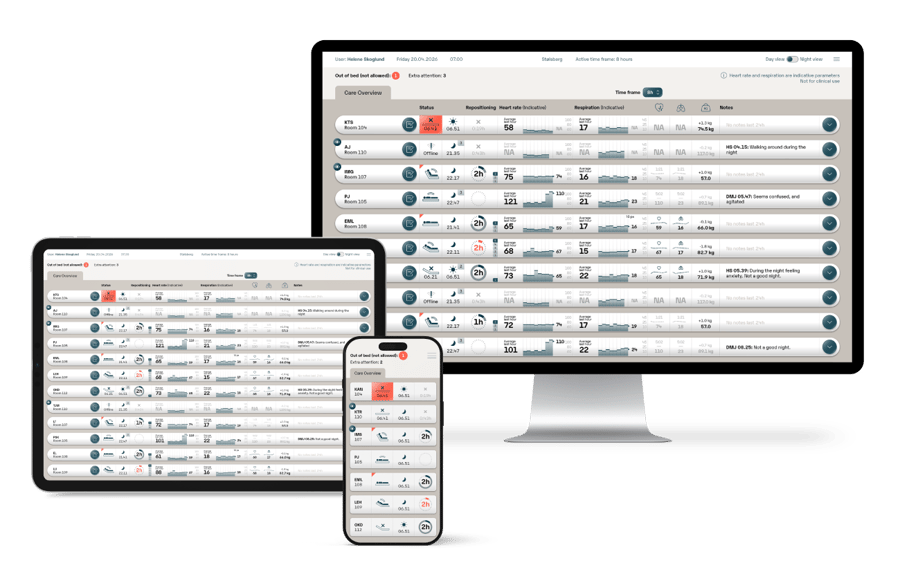
Through a simple and intuitive interface, care teams can quickly understand what is happening across their residents during the night. Staff can see whether a resident is in bed, has been out of bed for a prolonged period, or has returned safely to bed. They can also review overnight trends in heart rate, respiration rate, and movement to gain a clearer picture of the resident's night.
For residents who require repositioning, LYNG includes a repositioning timer that helps staff keep track of turning schedules without relying on manual reminders or documentation.
By bringing relevant information together in one place, LYNG helps care teams prioritize their attention, reduce unnecessary room checks, and gain better visibility during busy shifts.
It is designed to support care teams with better overview, particularly at night when staffing is limited and priorities can change quickly.
Looking ahead
Night shifts will likely remain one of the most demanding parts of nursing home care.
Staffing challenges, increasing care needs, and resident safety concerns are not going away.
But many providers are now exploring new ways to improve overview without increasing workload or disturbing residents unnecessarily.
Because better information doesn't replace caregivers.
It helps them focus on what matters most.
Curious how other nursing homes are approaching these challenges?
We're currently piloting LYNG in Norwegian municipalities and would be happy to discuss pilot opportunities and share what we're learning along the way.